Mathematics
The Structure Underneath Equations
Mathematics begins before formulas: with quantities, comparisons and rules we can justify. Why does three objects plus two objects give five, regardless of what we count? Work from that question toward equality, algebra, proof and more advanced ideas. This 26-step route is a conceptual introduction, not a complete mathematics curriculum.
Three introductory steps are open. Later lessons and account continuity are member features. Your work remains connected to the lesson you studied.
Begin with Quantity →Arithmetic Foundations
Learn the number system from the ground up: place value, addition, subtraction, multiplication, division, fractions, decimals, percentages and the first steps into algebra. Each lesson teaches a way of thinking, offers a second method, and lets you check your reasoning.
Begin Arithmetic Foundations →
This course is currently a local-browser foundation programme; it does not yet sync its checks to your member account.
What does 3 + 2 = 5 actually say?
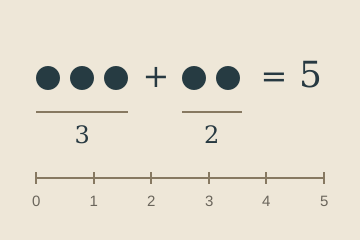
Three buttons and three stones have different properties, but both collections have the same number of objects. The numeral 3 represents that quantity; it is not the objects themselves.
Adding two more objects gives five, provided we count each object once and the groups do not overlap. The equality sign says both sides describe the same quantity.
Try the reasoning, not just the answer
If two groups share one object, can you add their counts without adjustment? No: the shared object would be counted twice. First decide what is being counted, then choose the operation.
Quantity · count without guessing
Quantity · count without guessing
Before arithmetic, there is a question: how many? Put three stones on the table. Now replace them with three books. The objects have changed, but the answer to “how many?” has not. The number 3 describes the size of either collection, not its colour, weight or purpose.
Why counting works
Count by pairing objects with the counting words: one, two, three. Each object must be paired with exactly one word. Do not skip an object or count one twice. The final counting word gives the cardinality—the number of objects in that collection.
Here is a stronger test. Arrange five coins in a straight line, then in a circle. Their appearance changes. Can you still pair every coin in the first arrangement with exactly one coin in the second? Yes. There are five in both. Spacing and arrangement do not change the count when no coins are added or removed.
What zero means
Remove every coin. The collection is empty; its count is 0. Zero is a number, not a failure to count. We need it to describe an empty group and, later, to make sense of subtraction and place-value notation.
What you must decide before counting
Ask what counts as one. If three boxes each contain four pencils, counting boxes answers a different question from counting pencils. Twelve pencils is not three boxes. The unit you count must remain consistent throughout the question.
Work it through. A photograph shows six buttons. Three are moved closer together, but none is added or removed. The count is still six. If one button is hidden behind another, the visible count may change; the actual collection does not. Distinguish the objects from what you happen to see.
Check the reasoning
Two groups have equal numbers of objects if you can match each member of one group with exactly one member of the other and leave none unmatched. You do not need identical objects. Later, addition builds on counting separate groups; it does not replace the need to identify the objects correctly.
Operation · combine without double-counting
Operation · combine without double-counting
Counting tells us the size of a collection. An operation tells us how to use numbers to obtain another number according to a rule. Addition is the first example.
Build addition from counting
Lay out three stones in one group and two in another. The groups do not overlap. Count them together: one, two, three, four, five. We write 3 + 2 = 5. The plus sign instructs us to combine quantities; the equals sign says the combined collection has the same count as five separate stones.
Try the groups in the other order: first two stones and then three. There are still five. For whole-number addition, exchanging the order of the groups does not change the total: 3 + 2 = 2 + 3. This is the commutative property, but the observation comes before the name.
Where the rule can go wrong
Suppose four students are in the chess club and four in the music club. One student belongs to both. How many different students belong to at least one club? Simply computing 4 + 4 gives eight memberships, not eight distinct students. That student has been counted twice. There are 4 + 4 − 1 = 7 distinct students.
The arithmetic is not mistaken. The mistake would be choosing an operation without understanding what is being counted. Before adding groups, check whether the groups are separate.
Why this matters later
An operation can also reverse another operation. If there are five stones and you remove two, three remain: 5 − 2 = 3. Subtraction answers a different question from addition. When we begin algebra, choosing the right operation—and performing the same legitimate transformation on both sides of an equality—will become essential.
Apply it to a new situation
A shelf contains three red books and two blue books, with no book in both categories. How many books are there? Five. But if a book can be both red-labelled and blue-labelled, you need to count the overlap before adding the category totals.
Optional: learning from mistakes
When an answer is wrong, inspect why it fails. Your explanation matters more than whether you guessed correctly the first time. Open the optional orientation →