Start with the world outside your window.
A message can cross an ocean before you finish reading this sentence. Satellites tell a farmer where rain is moving. A physician can look inside a living body without cutting it open. Money can change hands without either person touching a coin.
None of this arrived together.
Almost everything around you is an inheritance from people who solved problems before you were born—sometimes deliberately, sometimes accidentally, and often without understanding what their solution would eventually become.
To understand how we arrived here, we are going to travel backward.
Not through every event that happened. That would tell us almost nothing.
We are going to look for the moments when the world people could build, believe, measure or imagine changed.
And the first thing we have to lose is something you probably stopped noticing years ago.
The internet.
Take it away—not just websites and social media, but the ordinary expectation that information should arrive immediately. A map becomes something you carry. A newspaper tells you what happened yesterday. A letter can cross a border more slowly than you can. A library is again a place rather than something that follows you into bed.
Keep going and the mobile phone disappears with it. Then the personal computer. Then the communications satellites overhead. The world is still recognisably ours, but distance has begun to return.
An invisible virus becomes a public argument.
HIV was identified during a pandemic that changed medicine, public health and the lives of millions. Treatment eventually transformed the prognosis for many people with access to it.
But access was never distributed evenly. The history of a disease is also a history of institutions, stigma, patents, activism and decisions about whose survival can be financed.
Money moves without a banknote.
A shopkeeper receives a payment on a basic mobile phone. The customer need not carry cash or hold an ordinary bank account. A network of agents makes withdrawal possible far from a bank branch.
Mobile money expanded through several places and companies; Kenya’s M-Pesa, launched in 2007, became one of its best-known examples. The technology is recent. The older problem—how to transfer trust across distance—is not.
A message written for a cell can become medicine.
Imagine carrying instructions into a living cell rather than introducing the finished medicine. The cell reads the message and makes the protein itself. Messenger RNA does this naturally, but turning it into a usable therapy was another matter.
Katalin Karikó and Drew Weissman worked on a particularly stubborn obstacle: laboratory-made mRNA could provoke an unwanted inflammatory response. Their work on modified RNA building blocks helped make effective mRNA vaccines possible. When COVID-19 arrived, decades of apparently remote research suddenly mattered to millions.
Neither a discovery nor a vaccine belongs to two people alone. Laboratory teams, manufacturing workers, trial participants and public-health systems stand between a molecular insight and a dose in an arm. Remember that when history presents an invention as a single brilliant moment.
Evidence & context
The dated evidence belongs to the source. The interpretation and connections are the House’s editorial work.
One disease loses its human refuge.
For centuries, smallpox moved from person to person, leaving deaths, scars and fear in its wake. A vaccine existed long before the disease disappeared. That distinction matters.
The World Health Organization declared smallpox eradicated in 1980. Getting there required a global undertaking: vaccination, surveillance, local health workers who could find cases, and teams who followed the people those cases had encountered.
It is tempting to tell this as the triumph of one scientist. But a laboratory can make prevention possible while human organisation determines whether prevention reaches anyone. Medicine is discovery made dependable.
Evidence & context
The dated evidence belongs to the source. The interpretation and connections are the House’s editorial work.
A man in constant pain asks a nation to go to the Moon.
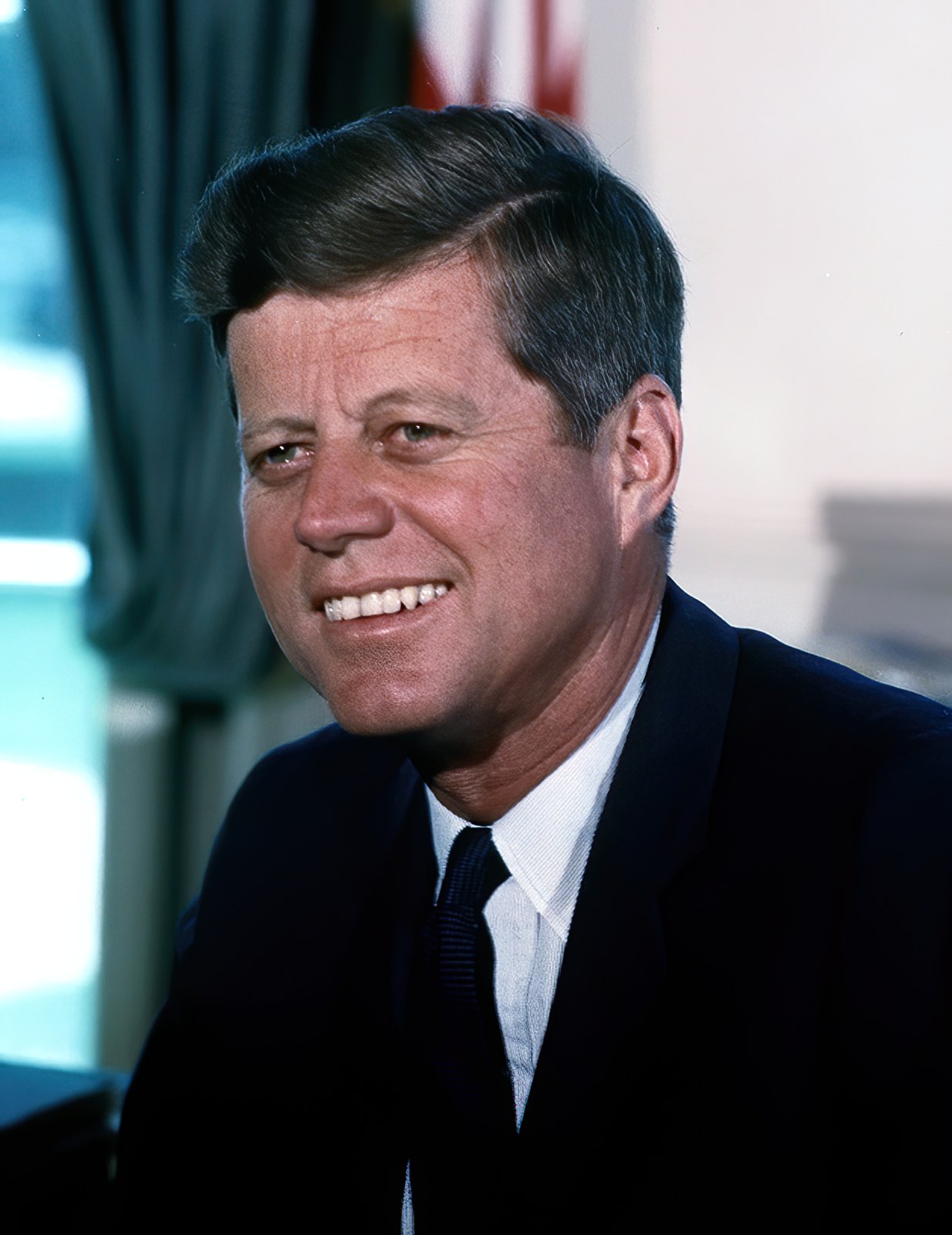
In May 1961, John F. Kennedy stood before Congress and committed the United States to landing a man on the Moon before the decade was out. Few in that chamber knew what standing there cost him. Kennedy lived with chronic back pain severe enough that he was fitted with a brace, and with Addison's disease, a hormonal disorder he and his staff kept from public view for most of his career. The man asking a nation to reach for something almost impossible was, privately, negotiating with his own body every day.
None of that made the commitment easier to keep. Kennedy did not live to see it kept. He was assassinated in November 1963, six years before the landing.
On 20 July 1969, Neil Armstrong and Buzz Aldrin brought Apollo 11's lunar module to the Moon's surface. Neither was a legend before that week. They were trained engineers and test pilots who had spent years doing exacting, unglamorous work—checklists, simulations, failures corrected in private—that the nine-minute descent depended on entirely. Their names became extraordinary. Almost none of the work that got them there was.
This is the pattern worth keeping, backward through everything that follows: capability rarely announces itself as heroism while it is being built. A man carries pain he does not show. Two others carry years of ordinary preparation. And afterward, something opens that did not exist before—not because the people were exceptional to begin with, but because they kept doing exacting work past the point where it would have been reasonable to stop.
A small sphere begins circling the Earth.
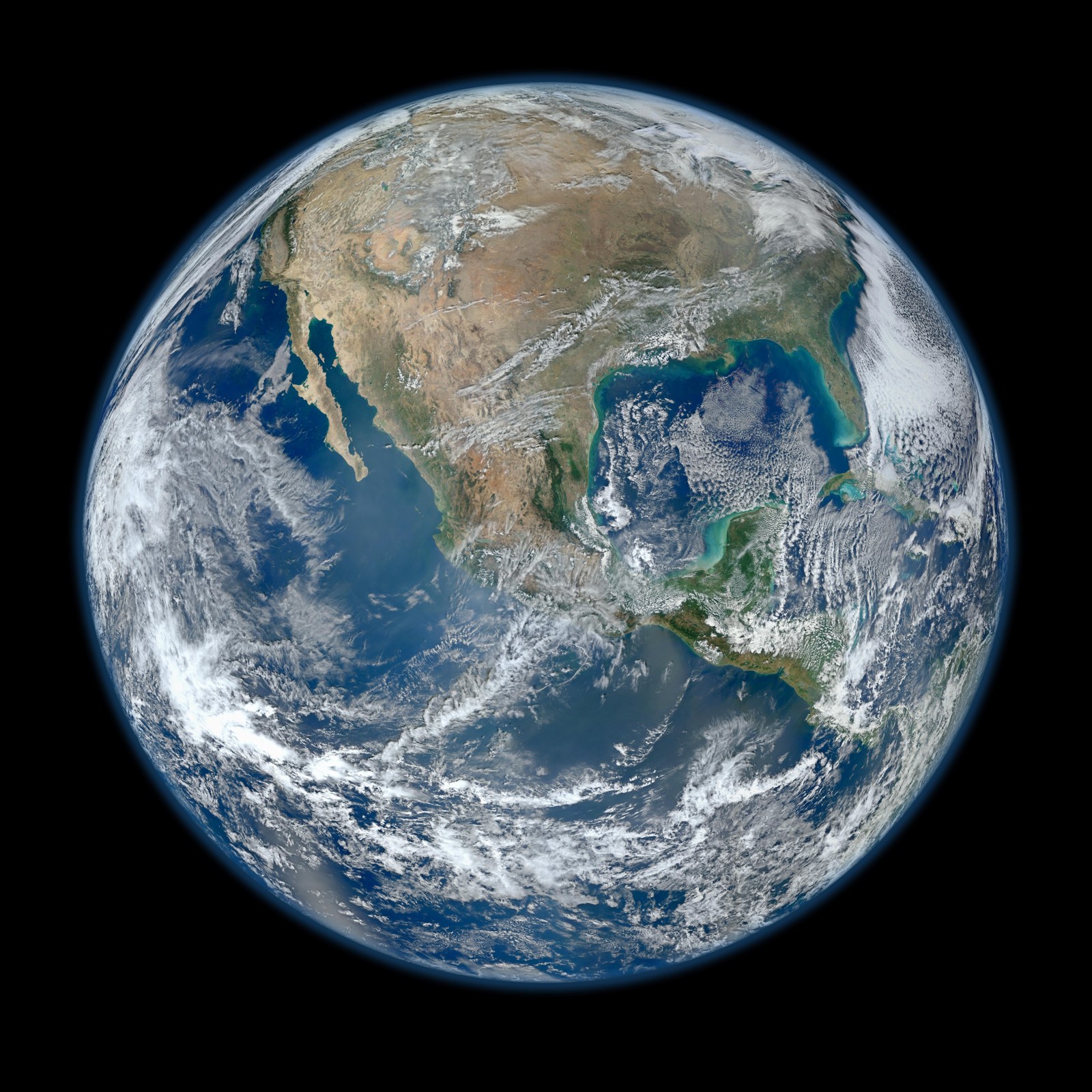
Sputnik 1 was not large. It did not carry people. Its radio signal did little more than announce that it was there. But on 4 October 1957 the Soviet Union had placed the first artificial satellite into Earth orbit.
The achievement mattered because orbit was not merely a new place to visit. It changed what could be observed, communicated and threatened across enormous distances. The same age that produced weather satellites and global communications also produced intercontinental missiles and nuclear deterrence. Human capability was not becoming good or bad. It was becoming larger.
And the political world beneath those satellites was changing just as quickly.
The map you recognise is younger than it looks.
At the end of the Second World War, European empires still governed enormous territories overseas. Over the following decades, independence movements, wars, negotiations and collapsing imperial authority produced new states across Asia, Africa, the Caribbean and elsewhere. The United Nations began in 1945 with 51 original members. By 1960 it had 99.
That did not mean empire simply vanished. Borders remained. Administrative systems remained. Languages remained. Trade routes, debts, military relationships and legal institutions survived the flags that had created them.
Meanwhile two states—the United States and the Soviet Union—possessed enough military power to make their rivalry a problem for almost everybody else. Nuclear weapons changed the meaning of victory: a war could be won so completely that there might be very little left worth winning.
So governments competed through alliances, intelligence services, technology, proxy wars, propaganda and prestige. A speech in Berlin, a revolution in Cuba, a war in Korea or Vietnam, a missile in Turkey or Cuba, a satellite overhead—events thousands of kilometres apart could belong to the same argument about power.
And beneath the rivalry, another transformation was taking place. People who had been treated as subjects were demanding citizenship. People legally excluded by race or sex were forcing political systems to confront the contradiction between the rights they proclaimed and the rights they actually distributed.
The modern world was learning to speak the language of universal rights while repeatedly discovering how difficult it was to live by it.
A flag is raised. The institutions remain.
Ghana’s independence in 1957 became a visible milestone of African decolonisation. Across the continent, political movements challenged imperial authority and argued over the form independence should take.
A flag can change in a day. Schools, administrative systems, borders, debts, languages and economic dependencies do not change at the same speed.
A promise names the human being.
After war and genocide, the United Nations General Assembly adopted the Universal Declaration of Human Rights. Its words had no magical power to prevent injustice.
They offered a common language in which states could be challenged—and exposed the distance between a declaration and the circumstances of people living under it.
A border arrives. Home is on the other side.
British India becomes independent India and Pakistan in August 1947. Pakistan initially has eastern and western wings, separated by Indian territory. The eastern wing later becomes Bangladesh.
The map can show the new states in two colours. It cannot show what happens when a road to a relative becomes a crossing between countries.
Partition brings mass displacement and communal violence. Independence and catastrophe occupy the same months. Neither cancels the other.
Read the official reports beside the experience they struggle to contain. A government sees movements of population. A person has to decide what can be carried.
The border is a political decision. Its consequences enter kitchens, fields, languages and memories.
Evidence & context
The National Archives · Partition documents ↗
The historical account is supported here. The questions about institutions and consequences are the House’s interpretation.
Now remove the assumption that progress makes us safer.
By the beginning of the twentieth century, industrial societies could move people, information and materials at speeds their grandparents had scarcely known. Railways joined cities. Telegraph cables carried messages across continents and oceans. Factories produced goods on a scale that transformed ordinary life.
Those same systems could move armies.
The First World War turned industrial capacity into sustained killing. The peace that followed did not settle the political crisis. Revolution created the Soviet state. Fascist movements rose. The Nazi regime turned racial ideology, bureaucracy, rail transport, policing and industrial organisation toward persecution and mass murder. The Second World War ended only after tens of millions of deaths and the use of atomic bombs against Hiroshima and Nagasaki.
There is a temptation to tell the history of knowledge as a staircase: discovery, improvement, progress. The first half of the twentieth century breaks that staircase.
The same civilisation that was learning astonishing things about matter was also learning how efficiently organised states could destroy human beings.
The useful substance still needs to reach the patient.
Alexander Fleming noticed something remarkable: a mould was interfering with bacteria. The observation would become famous. The medicine did not immediately follow.
Howard Florey, Ernst Chain, Norman Heatley and others helped turn penicillin into a substance that could be purified, tested and eventually manufactured in useful quantities. The hard part was not simply recognising that bacteria could be stopped. It was getting a reliable amount of the right substance to a person in danger.
History often remembers the person who first noticed the door. It needs to remember the people who made it possible to walk through.
Evidence & context
Science History Institute · Penicillin ↗
The dated evidence belongs to the source. The interpretation and connections are the House’s editorial work.
The sickness follows the troopship.
An influenza pandemic reached communities across the world, often through the same networks moving soldiers and supplies during the First World War.
The numbers remain uncertain, but the loss was immense. Greater connection can bring food, ideas and medical help; it can also carry disease.
The air above a field becomes part of its harvest.
Most of the air is nitrogen. Plants need nitrogen, but they cannot simply take the nitrogen gas floating above their leaves and use it as fertiliser.
Fritz Haber worked out a way to make ammonia from nitrogen and hydrogen. Carl Bosch helped turn the reaction into an industrial process. Fertiliser production changed the scale at which food could be grown. The same chemistry also supported explosives.
Here is one reason the history of inventions resists easy praise. A method can make human nourishment more dependable while also making destructive capacity more powerful. Chemistry does not choose between those uses.
Evidence & context
Science History Institute · Haber–Bosch ↗
The dated evidence belongs to the source. The interpretation and connections are the House’s editorial work.
Even space and time stop behaving normally.
For centuries, Newtonian mechanics had explained motion with extraordinary success. It was good enough to predict planets and build machines. There was no obvious reason to throw it away.
Then nineteenth-century physics produced a problem. Maxwell's equations described light as an electromagnetic phenomenon with a characteristic speed. Experiments made the old expectation of motion through a stationary luminiferous ether increasingly difficult to maintain. The pieces of physics that worked beautifully on their own no longer sat comfortably together.
In 1905 Albert Einstein asked what followed if the troublesome part was not light, but our assumptions about space and time.
The answer was special relativity.
It did not make Newton useless. It showed the conditions under which Newton's description is an extraordinarily good approximation—and the conditions under which reality refuses to cooperate with ordinary intuition.
If you want to stop here and understand the problem properly, read On Special Relativity. Your place in the chronology will still be here when you return.
A petition changes who counts in public.
Take an election and remove the assumption that all adults may participate. In most nineteenth-century democracies, that was not the world women inhabited.
In 1893, New Zealand became the first self-governing country to grant all adult women the parliamentary vote. Kate Sheppard helped organise the campaign, but the record also contains thousands of signatures from women whose names are rarely spoken aloud.
A political right is not an object someone can invent alone. People petition, argue, organise and insist; an institution eventually changes the rule. Then another generation has to ask whether the new rule is being honoured.
Evidence & context
New Zealand Ministry for Culture and Heritage · Suffrage ↗
The dated evidence belongs to the source. The interpretation and connections are the House’s editorial work.
The message arrives before the messenger.
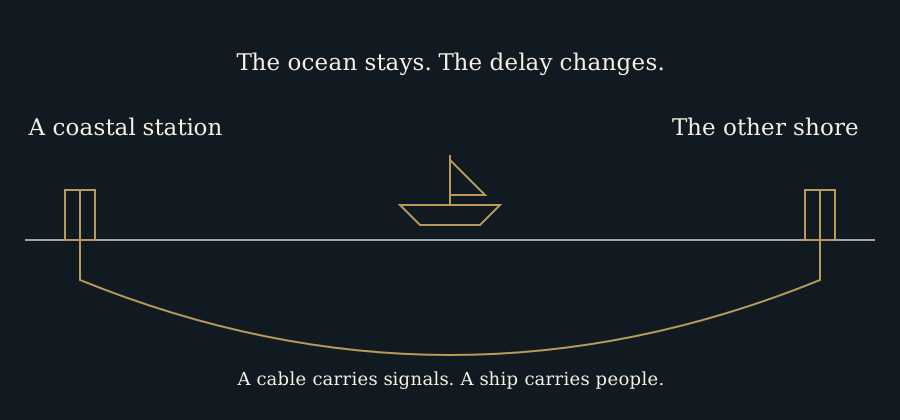
A working transatlantic telegraph cable connects the continents in 1866. Information no longer has to wait for a ship to carry it across the ocean.
For a diplomat abroad, distance had meant delay. Delay had also meant room to decide. Faster instructions give a distant government more immediate reach.
That is the less visible invention: not simply speed, but a new relationship between the centre and the person on the spot.
The official nearby knows things the capital does not. The capital can answer quickly enough to overrule them. More communication does not guarantee a fuller understanding.
Go backward once more. The ocean becomes time again.
Evidence & context
Office of the Historian · Telegraphy and diplomacy ↗
The historical account is supported here. The questions about institutions and consequences are the House’s interpretation.
The physician is refused a classroom.
Elizabeth Blackwell became the first woman to receive a medical degree in the United States in 1849. Her achievement did not make medical education suddenly open to all women.
Institutions often present a closed door as a neutral custom. The first person through may prove that the custom was not a law of nature.
Freedom is a journey somebody may have to make twice.
Harriet Tubman escaped from slavery in Maryland in 1849. Reaching freedom did not end the story, because she had left people she loved behind.
She returned repeatedly to the Eastern Shore to guide family and others away from enslavement. The routes depended on knowledge of roads and waterways, trusted contacts, timing, concealment and exceptional courage. An escape was not a speech about freedom. It was a series of dangerous practical decisions.
Think of transport as the ability to cross a distance. Then ask who is permitted to move, who is pursued for moving, and who must risk everything to help.
Evidence & context
US National Park Service · Harriet Tubman ↗
The dated evidence belongs to the source. The interpretation and connections are the House’s editorial work.
Night becomes negotiable.
Electric lighting spread through streets, workplaces and homes, though not at once and not for everyone. A city could begin to extend some of its working and social life beyond daylight.
The invention was never just a bulb. It required generators, wires, financing, standards and people who could maintain the whole system.
Before physics changed the universe, industry changed the day.
For most human beings who ever lived, the amount of work available from a person, an animal, moving water or wind placed hard limits on what could be made and moved. Steam power changed the scale of that bargain.
Factories gathered labour and machinery under one roof. Railways made inland distance cheaper. Telegraphy separated communication from the speed of a horse or ship. Industrial cities grew. Corporations and financial institutions learned to organise capital across undertakings too large for a single workshop.
But there was no single “Industrial Revolution” experienced in the same way by everybody. For an owner, a machine could multiply output. For a worker, it could reorganise the hours of the day. For an empire, steamships and railways could extend power. For an enslaved person in the Atlantic world, rising industrial production elsewhere did not mean freedom.
And while engines transformed work, electricity was becoming something stranger than a useful shock.
Michael Faraday showed that electricity and magnetism could be understood through fields and induction. James Clerk Maxwell later expressed the relationship mathematically—and the mathematics implied that light itself belonged to the same electromagnetic story.
The road to Einstein had begun before Einstein was born.
Two cities begin keeping a different kind of time.
A city can be close on a map and still be far away in hours, cost and risk. For most travellers, the distance between two places has always been measured in more than miles.
The Liverpool and Manchester Railway opened in 1830 as a new kind of inter-urban railway, linking a port and a manufacturing city. Trains moved people and goods on a dependable route. Workplaces, markets and eventually daily expectations of time began to change around the service.
The invention was not merely a locomotive. It was a working system of tracks, stations, schedules, finance, labour and trust that made movement repeatable.
Evidence & context
Science and Industry Museum · Liverpool Road ↗
The dated evidence belongs to the source. The interpretation and connections are the House’s editorial work.
He wrote his mathematics down the night before the duel.
Évariste Galois was twenty years old when he died from a pistol wound the next morning, in a duel over a woman whose full identity historians still dispute. The immediate cause of his death was a matter of the heart. The reason it mattered to mathematics was almost incidental to that night — and everything to do with what he had already done.
Galois had spent his short adult life trying to get a demanding, original theory of equations taken seriously by the mathematicians who could have championed it. Papers were lost by the referees reviewing them. One reviewer reportedly found the work simply too condensed to follow. Recognition, when it came, came decades after he was no longer alive to receive it.
On the night before the duel, expecting to die, Galois stayed up writing — annotating his manuscripts, trying to compress a life's unfinished thinking into a form someone else might later complete. What survived became the foundation of group theory, a way of describing symmetry that now sits underneath chemistry, physics and cryptography alike.
He was right that he would not survive the morning.
An unfamiliar practice crosses a border.
Lady Mary Wortley Montagu encountered smallpox inoculation in Ottoman society and advocated its use in Britain. The practice existed in different forms elsewhere before she encountered it.
A society can possess a useful technique and still fail to accept it. Medicine also has a history of translators, sceptics, patients and social trust.
A milkmaid helps change the history of disease.
Long before modern vaccination, communities in parts of Asia and Africa practised forms of smallpox inoculation. In the Ottoman Empire, Lady Mary Wortley Montagu witnessed such practices and helped bring them to attention in Britain.
Edward Jenner later investigated the apparent protection associated with cowpox. In 1796 he tested the idea through an experiment involving James Phipps and material obtained from Sarah Nelmes. The experiment itself would not satisfy present-day ethical standards.
The history is larger than Jenner. Farmers noticed patterns, families carried practical knowledge, and later generations tested, standardised and distributed a method that could save lives.
Evidence & context
WHO · History of smallpox vaccination ↗
The dated evidence belongs to the source. The interpretation and connections are the House’s editorial work.
The plantation produces wealth and rebellion.
Sugar depended on land, forced labour, commerce and violence. The Haitian Revolution confronted an Atlantic economy that could proclaim liberty while treating enslaved people as property.
To understand a commodity, follow it beyond the buyer’s table. Ask who grew it, who transported it and who had the right to refuse.
Freedom reaches the people a declaration left outside.
In the French colony of Saint-Domingue, an uprising of enslaved people begins in 1791. Through revolution and war, emancipation becomes a struggle for a state that can defend it. Haiti declares independence in 1804.
The familiar language of liberty changes when spoken by someone whom the economy treats as property.
A plantation can appear in a distant ledger as productive land. From inside it, that productivity means coerced work and violence. The ledger does not become false by omitting the person. It becomes insufficient.
The revolution belongs inside the history of modern freedom. Leave it outside and the word begins to describe what governments proclaimed rather than what people fought to make real.
Evidence & context
Smithsonian · A revolutionary world ↗
The historical account is supported here. The questions about institutions and consequences are the House’s interpretation.
Now make copying expensive again.
Take away the industrial press, then the newspaper, then the cheap printed book. A text once again has to be copied by hand or produced through slower, more expensive methods. Knowledge still travels—but fewer identical copies can travel together.
Movable-type printing in Europe did not invent writing, books or printing. What it did was alter the economics of reproduction. An argument, translation, diagram or accusation could be multiplied with a speed and consistency that changed the audience available to it.
That mattered when Martin Luther's challenge to Church authority became part of a much larger religious fracture. It mattered when scholars compared texts. It mattered when observations, tables and diagrams could circulate among people trying to understand nature.
But printing alone did not create the Reformation or the scientific revolution. Technologies do not reach into history and pull a lever marked change. People use them inside institutions, conflicts and beliefs that already exist.
By the seventeenth century, figures such as Galileo, Kepler and Newton were helping to establish a new confidence that nature could be interrogated through observation, experiment and mathematics.
Newton's achievement was so powerful that, for generations, the physical universe could appear almost clocklike: matter moving under laws that mathematics could state.
We have now travelled far enough backward that something familiar is beginning to disappear.
The modern assumption that new knowledge will quickly reach everyone who wants it.
One man lost part of his face over a mathematical argument. The other wrote his own epitaph in advance.
Tycho Brahe was a young Danish nobleman, already known for his precise astronomical observations, when in 1566 he fought a sword duel with a cousin over — accounts differ — either a mathematical formula or wounded pride about whose family produced the better mathematician. He lost part of his nose and spent the rest of his life wearing a prosthetic replacement, reportedly made of brass. It did not slow him down; his later observatory produced the most accurate naked-eye astronomical data Europe had ever recorded.
Johannes Kepler joined Tycho as his assistant in 1600, inherited that data after Tycho's death the following year, and spent the next decade wrestling with it — eventually abandoning the assumption, held since antiquity, that planets move in perfect circles. What he found instead were ellipses, and the three laws of planetary motion that still carry his name.
Kepler wrote his own epitaph before he died: Mensus eram coelos, nunc terrae metior umbras. Mens coelestis erat, corporis umbra iacet — "I measured the skies, now I measure the shadows of the earth. Though my mind was of the sky, the shadow of my body lies here." The grave itself was destroyed within a few years, in the Thirty Years' War. The line survived without it.
One man's data. Another man's insight. Neither result would exist without both.
A ship follows the wind rather than a road.
Merchants, sailors and pilgrims linked East Africa, Arabia, India and Southeast Asia through routes shaped by seasonal monsoons. Ports such as Kilwa and Calicut belonged to connected commercial worlds.
An ocean is not necessarily an empty distance. Knowledge of winds, credit, vessels and languages can make it a corridor.
The desert does not prevent a city of books.
Timbuktu sits near the southern edge of the Sahara. It is easy to imagine the desert only as a barrier. For traders who knew its routes, it could also be crossed.
Gold, salt, grain and other goods travelled through the region. Manuscripts travelled too. Scholars, teachers, copyists and students helped make Timbuktu a centre of Islamic learning. A book could be an object of trade, a working tool or the inheritance of a family.
We have met Europe's printing workshops. Now meet a different world in which texts circulated through networks of study and commerce. The important question is not which civilisation owned learning. It is how people kept it alive.
Evidence & context
The dated evidence belongs to the source. The interpretation and connections are the House’s editorial work.
The telescope refuses to flatter us.
When telescopes began revealing moons circling Jupiter and the changing appearance of Venus, familiar pictures of the cosmos came under pressure.
The instrument did not solve every astronomical dispute by itself. It forced observers to accommodate what the sky was showing rather than only what inherited authorities said it ought to show.
A page becomes something a workshop can repeat.
By about 1455, Gutenberg’s workshop has produced its Latin Bible. Movable metal type lets a page be composed, printed, and its letters used again.
The book still looks toward manuscript culture. A new production system need not announce itself with a new visual language.
Printing changes the economics of repetition. Preparing the type is laborious. Once prepared, the same arrangement can leave more than one impression.
An error can now travel in company. So can a correction, an argument, a translation. Authority has acquired another means of multiplying itself—and of being challenged.
This is a European transformation, not the beginning of printing everywhere. Farther back, a dated Chinese scroll will remove that easy mistake.
Evidence & context
Morgan Library · Gutenberg Bible ↗
The historical account is supported here. The questions about institutions and consequences are the House’s interpretation.
The earliest surviving metal-type book is not European.
Turn a piece of text into a set of movable characters. Arrange them, print them, separate them, and use them again. The promise is not only more copies; it is that making a copy no longer requires rewriting every character by hand.
In Korea, the Buddhist text known as Jikji was printed using movable metal type in July 1377. It is the oldest surviving evidence of a book produced by this technique. That does not make it the first occasion on which somebody used metal type.
Sixteenth-century Europe did not invent the human desire to reproduce knowledge. Histories of technology become more truthful when several lineages can appear without being forced into a race.
Evidence & context
UNESCO Memory of the World · Jikji ↗
The dated evidence belongs to the source. The interpretation and connections are the House’s editorial work.
A man gets lost in a wood.
That sounds smaller than the world we have been travelling through.
It isn't.
Dante Alighieri begins The Divine Comedy with a traveller who has lost the straight way. To understand what follows, you need the world around him: a Christian imagination of judgment and salvation, the authority of classical poetry, the politics of Italian cities, exile, love, memory—and one human being trying to understand what a life is for.
The imagined journey is set in 1300. The poem itself was written later, after Dante had been driven from Florence. That distance matters. A journey through the afterlife also became a way of looking back at the living.
Now the copies become people again.
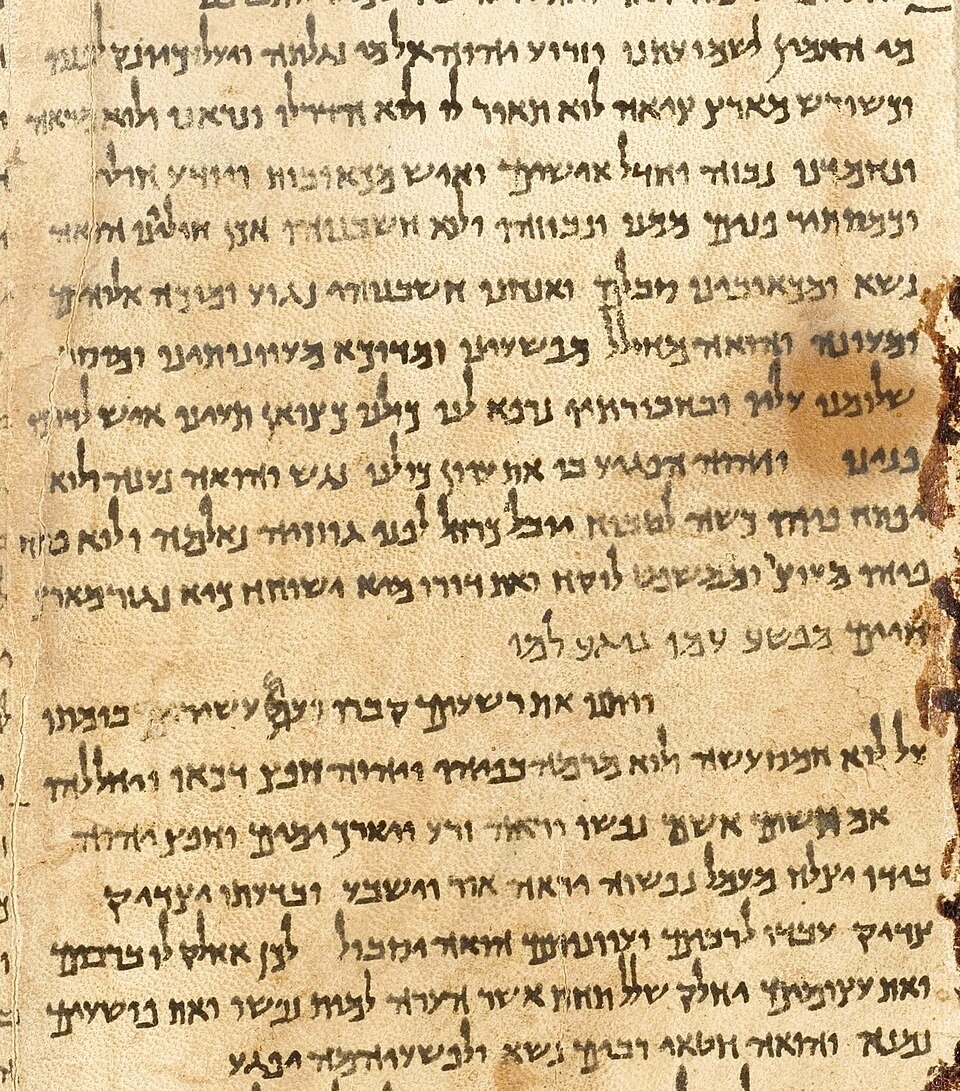
Keep travelling backward and the printed page begins to loosen its grip. A book is no longer one of thousands of near-identical objects. It may be parchment prepared from animal skin, folded and gathered, ruled, written by hand, corrected by hand and sometimes illuminated by another hand entirely.
This changes more than the price of a book. It changes what survival means. A text can disappear because nobody copies it. It can change because somebody does. The copy in front of us may have been made centuries after the words were first composed.
That does not make the medieval world intellectually empty. Monasteries, cathedral schools, courts and—later—universities copied, argued over and reorganised inherited learning. Latin connected scholars across western Europe. Arabic scholarship carried, criticised and extended bodies of Greek, Persian and Indian learning. Jewish intellectual communities worked across languages and political worlds of their own.
The deeper we go, the more often a simple question—How do we know this?—will matter as much as the event itself.
The messenger outruns the traveller.
Across the Mongol Empire, relay stations helped officials and messengers carry information through enormous distances. The network depended on animals, roads, labour and political authority.
Empire can destroy and connect at the same time. Roads and relay systems do not erase the violence through which control was established.
A wall can stand without mortar.
At Great Zimbabwe, builders raised immense dry-stone walls without binding them with mortar. The stones remain fitted together centuries after the society that assembled them changed.
The city belonged to ancestors of the Shona. It was part of an African landscape of settlements, trade and political authority, not an isolated mystery placed on the map by outsiders. Colonial visitors later tried to assign its achievement to foreigners; the archaeology does not require that story.
A wall is evidence of skill. It is also evidence of coordinated labour, design, resources and the decisions of people whose individual names were not preserved.
Evidence & context
Metropolitan Museum of Art · Great Zimbabwe ↗
The dated evidence belongs to the source. The interpretation and connections are the House’s editorial work.
A promise needs someone able to enforce it.
King John seals Magna Carta in 1215. The settlement with his barons fails to end their conflict. Later reissues help give the charter a life beyond that immediate failure.
Do not put modern democracy into the meadow. This is a society of ranks and privileges. A restraint on royal power is not yet equal political standing for everyone.
But stay with the practical difficulty. If a ruler promises to observe limits, who can act when the promise is broken?
A written right, an institution able to defend it, and a person permitted to claim it are three different things.
The later life of a document can be much larger than the intention of those who first accepted it. That later life is history too.
Evidence & context
National Archives · Magna Carta ↗
The historical account is supported here. The questions about institutions and consequences are the House’s interpretation.
A promise on paper begins moving like money.
Coins have weight. Carry enough of them and their inconvenience becomes a fact of daily commerce.
In China, forms of paper money developed long before printed banknotes became familiar in Europe. The paper was not valuable because it was useful for jewellery or tools. It depended on institutions and people accepting that it could stand in for payment.
Money has never been only metal. It is also a social agreement. The interesting history begins when a community trusts an object enough to let a transaction continue without exchanging the underlying goods.
Evidence & context
Smithsonian · Forms of money ↗
The dated evidence belongs to the source. The interpretation and connections are the House’s editorial work.
Europe is not the centre of the world.
From the Atlantic coast, it is easy to narrate these centuries as though Rome fell, Europe went dark, and eventually modernity switched the lights back on.
That story is too small.
Across the Islamic world, cities from Córdoba to Baghdad belonged to networks of trade, government and scholarship stretching across North Africa, the Middle East and far beyond. In China, powerful dynasties governed enormous populations and developed administrative, commercial and technological systems of their own. Across Africa, states and trading societies connected gold, salt, ivory and other goods to regional and long-distance markets. In the Americas, complex societies grew without any knowledge that Europe existed.
Human history has never had a single stage.
And in the thirteenth century, the Mongol conquests made that fact impossible for much of Eurasia to ignore. Armies originating on the steppe shattered states across enormous distances. The violence was immense. So was the resulting movement of people, goods, technologies, information and disease across territories brought into closer contact.
The world was connected long before it was global in the modern sense.
A book asks to be given away.
A surviving printed Diamond Sutra carries a date: 11 May 868. Its Chinese text was translated by Kumarajiva. The British Library preserves the scroll as Or.8210/P.2.
Woodblocks make text and image repeatable together. Here the form is a scroll, not a European codex. There is more than one way for a book to be a book.
Place it beside Mainz, almost six centuries later. The comparison does not reduce history to a race for the first invention. It asks what a technology enables within different institutions and reading cultures.
A surviving dated object proves that printing was happening by this date. It does not prove that this was the first time someone printed.
Evidence & context
British Library · dated Diamond Sutra, Or.8210/P.2 ↗
The historical account is supported here. The questions about institutions and consequences are the House’s interpretation.
Translation becomes a new kind of invention.
In Abbasid scholarly circles, works from Greek, Sanskrit, Persian and other traditions were translated, studied and extended. Mathematics and astronomy changed through this traffic of texts and people.
Knowledge seldom travels unchanged. A translator has to understand an argument before another person can build upon it.
An unknown quantity becomes something you can work with.
Suppose a trader knows the total but not one of the amounts that produced it. The missing number is not a nuisance to be guessed at; it is a relationship to be resolved.
In ninth-century Baghdad, al-Khwarizmi organised methods for solving equations. His algebra did not arrive as a complete invention independent of earlier mathematics. Indian numerals, Greek problems and mathematical work circulating across several languages formed part of the larger inheritance.
His name would travel into the word algorithm. More important than the name is the change in habit: mathematics can describe what is unknown precisely enough that the unknown becomes findable.
Evidence & context
MacTutor · Mathematics in the Islamic world ↗
The dated evidence belongs to the source. The interpretation and connections are the House’s editorial work.
A coast speaks many languages.
The Swahili coast grew from African communities participating in Indian Ocean exchange. Commerce helped produce distinctive towns, architecture and literary traditions.
The coast was not a passive destination for foreign traders. Its inhabitants selected, adapted and created institutions of their own.
A journey can be built into stone.
Borobudur rises in central Java as a Buddhist monument of terraces, galleries, reliefs and stupas. A visitor does not merely look at a façade. The architecture gives movement a form.
Reliefs guide attention through stories and ideas. Circling and ascending the monument becomes part of engaging with its religious world. Stone, labour, image and ritual work together.
Buildings do not always serve only to shelter bodies. Sometimes they also shape memory, practice and the way a person understands their place in existence.
Evidence & context
UNESCO · Borobudur Temple Compounds ↗
The dated evidence belongs to the source. The interpretation and connections are the House’s editorial work.
Remove the borders first.
Take a modern map of Europe and begin rubbing out the lines.
France does not disappear, because modern France is not there yet. Neither are England, Germany or Italy in the form you know them. The names may be familiar. The political objects are not.
Power sits in overlapping places: a king, a lord, a bishop, a monastery, a town, a family with land and armed followers. A border can be less a line than an argument about who can command whom—and how far away that command still works.
Christianity is already woven deeply into this world. But do not imagine one machine called “the Church” descending unchanged through the centuries. Bishops, monasteries, rulers, theologians and ordinary believers preserve, dispute and reshape an inheritance while becoming entangled with power themselves.
Now ask where so much of the machinery beneath this world came from.
One answer keeps appearing under our feet.
Rome.
Elsewhere, words are becoming an inheritance.
In western Arabia, Muhammad begins proclaiming revelations that Muslim tradition receives as the Qur’an.
Do not reduce what follows to a book appearing on a shelf. Recitation, memory, community, conflict, law, worship and political authority will all become part of the history through which the text travels.
For a Muslim reader, the Qur’an is revelation. For a historian, manuscripts, reports, material evidence and later transmission raise questions that have to be handled with their own methods.
Those statements are not required to cancel one another. They answer different kinds of question.
A pilgrim carries more than belief.
Xuanzang travelled from China to India in search of Buddhist learning and later translated texts. His record also preserves observations about places and institutions he encountered.
A religious journey can become an intellectual bridge. The traveller does not merely transport a book; he brings questions shaped by another world.
Nothing becomes a number with rules of its own.
An empty place is not the same thing as a number. In 205, a zero can tell you that there are no tens; in an equation, zero can also be something you add, subtract or multiply.
Indian mathematical traditions gave the modern decimal place-value system essential features. In 628, Brahmagupta wrote rules treating zero and negative quantities in arithmetic, using the language of fortunes and debts. Some of his conclusions, especially concerning division by zero, were not correct by modern standards.
This is how mathematics grows: not through infallible inventors, but through better ways of expressing a problem and exposing what a rule can—and cannot—do.
Evidence & context
The dated evidence belongs to the source. The interpretation and connections are the House’s editorial work.
An empire changes without vanishing everywhere.
Political authority in the western Roman Empire fragmented, while the eastern empire continued from Constantinople. Local life and institutions changed unevenly across regions.
A familiar date can be convenient for a textbook and misleading for a human life. Not everyone wakes up on the same morning inside a new age.
An empire can end without the world ending with it.
The western Roman imperial government fragmented during the fifth century. Armies, rulers and peoples conventionally described as Goths, Vandals, Franks and others established kingdoms in territories that had belonged to Rome.
But a person living through the change did not wake one morning in “the Middle Ages.” Roman law, roads, cities, Christian institutions, taxation, languages and habits survived unevenly. In the east, the Roman Empire continued from Constantinople for almost another thousand years.
This is a useful warning about chronology. Historians need dates because dates let us orient ourselves. Human worlds rarely obey them.
If you want to enter the empire rather than merely pass through it, go to Rome. Your place here remains the fifth century.
Put two things beside each other.
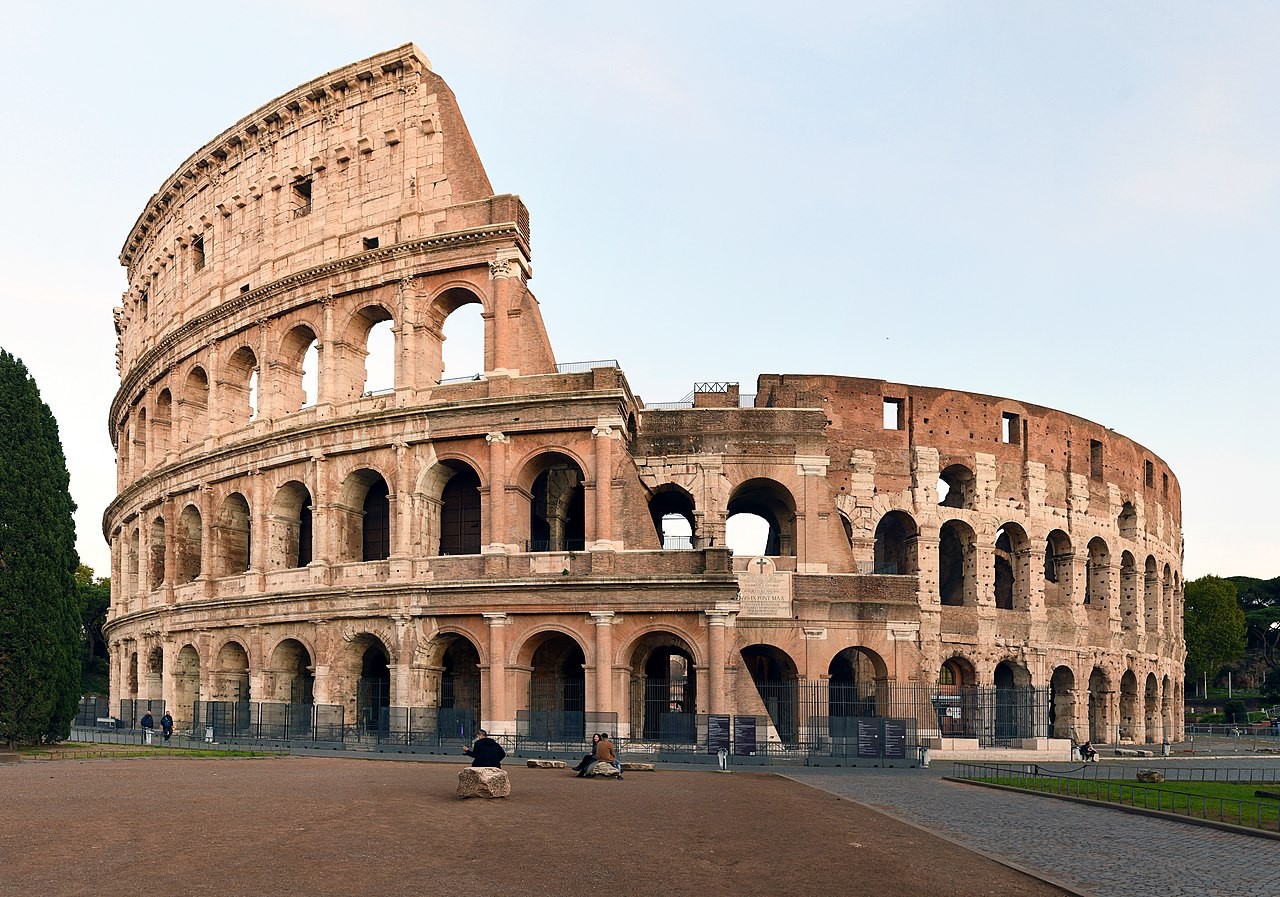
On one side: an empire with roads, courts, officials, cities, money, law and the habit of making decisions travel.
On the other: Christian communities that have spent generations learning how to survive without commanding any of it.
Then an emperor begins to favour them.
The beliefs do not suddenly appear. The Roman machinery does not suddenly become Christian. Something more consequential happens: structures that already existed separately can now act upon one another.
Constantine supported Christianity and intervened in disputes within the Church. Later in the century, under Theodosius I, Nicene Christianity received imperial backing as official orthodoxy.
Older religious practices persisted. Christians still disagreed. But a theological argument could now acquire an imperial audience—and imperial consequences.
We already have a finished room here: follow Constantine.
A road becomes a meeting place for religions.
Trade routes across Central and South Asia carried merchants, missionaries, stories, languages and images. Buddhism moved through networks rather than along one uninterrupted road.
No single route explains its transmission. Movement meant adaptation, and adaptation left visible differences in art, ritual and texts.
A kingdom stands between three worlds.
At Aksum in what is now northern Ethiopia, towering stone stelae marked an important kingdom. Trade linked it to the Red Sea, Arabia, parts of Africa and the Mediterranean.
Its rulers left inscriptions in different languages. Under King Ezana in the fourth century, Christianity became an important part of the kingdom’s political and religious history. The surviving objects include monuments, inscriptions and traces of roads by which people and goods travelled.
If the ancient world in your mind contains only Rome, Persia and China, this kingdom changes the map. Their worlds were already connected, though never equally.
Evidence & context
The dated evidence belongs to the source. The interpretation and connections are the House’s editorial work.
Water reaches a city that did not grow it.
Aqueducts carried water across varied landscapes to towns and cities in the Roman world. Gradients, materials and maintenance mattered as much as the monumental arches we photograph.
An impressive public structure is only the visible portion of a system. Someone must keep water moving after the architect has left.
A calculation needs to persuade somebody else.
The Nine Chapters on the Mathematical Art collected practical mathematical problems: measuring land, working with fractions, distributing goods, resolving unknown quantities.
In the third century, Liu Hui wrote a commentary that examined why mathematical methods worked. Some of the questions were geometrical. Others belonged to the everyday world of administration, trade and surveying.
It is easy to mistake a method for an instruction to remember. A careful explanation asks for more: what relationship makes this method valid, and where would it cease to apply?
Evidence & context
MacTutor · Chinese mathematics ↗
The dated evidence belongs to the source. The interpretation and connections are the House’s editorial work.
Now remove Christianity from Christianity.
Take away the cathedrals. The councils. The later papacy. The monasteries. The creeds written after long arguments. Even the word “Christianity” begins to feel too finished for what remains.
We arrive in Roman Judaea.
Jesus of Nazareth is a Jew. His earliest followers are moving inside Jewish religious life, scripture, expectation and dispute. The movement that will eventually spread across the Mediterranean does not yet know the centuries waiting for it.
And here the ground beneath us changes slightly.
Roman history and archaeology can tell us some things. Jewish sources tell us others. Early Christian writings are indispensable—but their authors were not standing outside the events writing modern biographies for future historians.
So from here onward, one question begins travelling with us:
What kind of evidence am I looking at, and what can it actually establish?
We will need that question more, not less, as the written record thins.
Someone measures a field and leaves behind a mathematics book.
Imagine a farmer calculating how much land can be planted, or an official dividing provisions among workers. These are not small mathematical questions because they lack abstract notation. They require exact relationships.
The Nine Chapters on the Mathematical Art grew from Chinese mathematical traditions into a collection of 246 problems covering surveying, fractions, trade, engineering and other practical affairs. The surviving text reflects work accumulated over time, not the achievement of one identifiable inventor.
Mathematics did not have to look like a Greek proof to be intellectually serious. Different civilisations developed distinct practices for demonstrating that a calculation could be trusted.
Evidence & context
The dated evidence belongs to the source. The interpretation and connections are the House’s editorial work.
Jerusalem is small enough to miss on an imperial map.
That does not make empire small to Jerusalem.
A ruler hundreds of kilometres away can decide who governs here, what tribute is owed, whether a rebellion is tolerated and what happens after it fails.
Rome is only the latest enormous power to discover this landscape.
Before Rome came Hellenistic kingdoms born from Alexander's conquests. Before them Persia. Before Persia, Babylon. Before Babylon, Assyria.
The names sound like a list until you stand in the smaller place.
Then each name can mean taxes, soldiers, a governor, deportation, permission to rebuild—or a city burning.
And now something useful happens for us: Biblical history begins to touch records and objects produced by the other people in the room.
Human beings elsewhere are asking what action requires.
Chronology becomes misleading if every road is forced through the Mediterranean.
In South Asia, the Mahābhārata takes shape across centuries. Within it, the Bhagavad Gita places Arjuna before a problem that survives its battlefield: what do you do when action itself has become morally difficult?
The text does not arrive as a modern productivity maxim. It speaks through duty, action, attachment, knowledge and devotion inside traditions with long histories of disagreement and commentary.
We do not have to adopt its metaphysics to notice the human problem.
How do you act when you cannot control what your action will produce?
The same opening can belong to different acts of reading.
Genesis opens the Torah, the five books at the beginning of the Jewish Tanakh. Christians also receive Genesis within their Old Testament. Shared textual ancestry does not make the two reading traditions interchangeable.
A narrative about beginnings is not a timestamp for its own composition. The formation of these books extends across a debated history of writing, editing and transmission. No single date here claims to settle it.
Read the Jewish doorway in its own setting. Then enter the Christian Bible through its own reader. The distinction is carried by the destination, not just by the label.
History keeps the relationship visible without asking either tradition to disappear into the other.
Torah · Genesis in the Jewish tradition →
Bible · Genesis in the Christian collection →
Evidence & context
Sefaria · Genesis and Jewish commentary ↗
Society of Biblical Literature · the formation of the Torah ↗
The historical account is supported here. The questions about institutions and consequences are the House’s interpretation.
An emperor writes remorse into stone.
Ashoka’s inscriptions describe concerns about moral conduct and governance following imperial expansion, including reflections on violence. They were addressed to audiences distributed across a wide territory.
A ruler’s inscription is evidence of what authority wished to say. It is not proof that everyone lived according to its promises.
A soldier finds an old man drawing circles in the sand.
Syracuse fell to Rome in 212 BCE after a siege the historian Plutarch says Archimedes' own war machines had held off for two years — catapults, grappling cranes, devices that made the Roman fleet afraid to approach the walls directly. When the city finally fell, Roman soldiers had orders to bring Archimedes back alive. He was, by then, the most famous mind in the Mediterranean.
According to the accounts that survive, a soldier found him in his courtyard, absorbed in a geometric diagram traced in sand or dust, working through a problem. Archimedes told him not to disturb it. The soldier killed him where he sat.
We cannot verify the scene word for word — the story reaches us through later Roman writers, not an eyewitness transcript. What is not in doubt is the body of work he left: a formula for the volume of a sphere he considered his finest result, principles of levers and buoyancy still taught unchanged, and a habit of mind that treated a diagram as more urgent than his own survival.
He asked that a sphere inscribed in a cylinder be carved on his tomb. Cicero, more than a century later, said he found that tomb overgrown and forgotten, and had it cleared.
Now Greece stops being one word.
Before Rome dominated the eastern Mediterranean, Greek language and culture had already travelled far beyond the Aegean. Alexander of Macedon conquered the Persian Empire in the fourth century BCE. After his death, successor kingdoms ruled territories stretching from Egypt and the Near East deep into Asia, mixing Greek institutions and artistic forms with older local traditions.
Keep going backward and even that Hellenistic world disappears. We arrive among independent Greek poleis—city-states with different laws, social orders and ideas about who counted as a citizen.
Athens and Sparta make the contrast impossible to miss.
Athens developed a democracy in which male citizens could participate directly in public decision-making. That political experiment was remarkable. Its boundaries were remarkable too: women were excluded from citizenship, slavery was embedded in the economy, and Athens itself became an imperial power over other Greek communities.
Sparta organised power differently. A small body of full Spartan citizens lived inside a system shaped by military discipline and supported by the labour of helots—an unfree population, many of them Messenians whose land had been conquered. Spartan women occupied a different social and economic position from Athenian women, including substantially greater scope to hold property, but Sparta was not therefore an egalitarian society.
Two societies faced overlapping problems—security, citizenship, education, labour, wealth, power—and built strikingly different answers.
Do not choose the winner yet. Notice the machinery.
This world now justifies a door. Enter the Greek world, or look closely at Sparta. Both return you here.
A conqueror enters Babylon and calls himself a restorer.
In 539 BCE, Cyrus II of Persia takes Babylon.
Conquest is the obvious fact. The more revealing object is a clay cylinder produced afterward.
It does not speak like a modern press release, but it performs a recognisable political task: Cyrus presents himself in the language of a legitimate Mesopotamian ruler, restoring cults and returning displaced divine images and peoples.
Biblical texts remember the same ruler from another position: Cyrus permits Judean exiles to return and the temple at Jerusalem to be rebuilt.
Do not flatten those voices into one.
The cylinder helps us see Persian royal policy and self-presentation. The Biblical texts preserve Judean memory and interpretation. Archaeology and administrative records add other pieces.
No single piece has to pretend to be the whole floor.
Now take away the things that make a people feel permanent.
The king is gone. The city is defeated. The temple is destroyed. Families have been carried into another empire.
This is Jerusalem after the Babylonian conquest under Nebuchadnezzar II in 587/586 BCE.
On a timeline, Judah has changed colour.
For the people inside the event, a harder question has appeared: if land, monarchy and sacred centre can all be lost, what exactly makes us us?
Some Biblical literature speaks from, remembers or interprets that catastrophe. Babylonian records and archaeology illuminate parts of the same political world from outside it.
The Bible is now becoming one of the great textual inheritances travelling beside us.
Beside us—not over every other source.
A different agricultural inheritance.
Communities in the Americas developed crops, cultivation and food systems on their own trajectories. Maize became central to many societies across Mesoamerica.
There was never one universal cradle from which all useful plants spread. Human societies experimented with the landscapes available to them.
A piece of metal begins carrying an agreed value.
People exchanged goods, measured obligations and used forms of money long before coins became ordinary. A coin did not create commerce from nothing.
In Lydia and China, forms of metal currency appeared during the first millennium BCE. Other traditions of coinage developed elsewhere, including the Indian subcontinent. The shapes differed; some Chinese examples resembled small tools.
A coin succeeds when someone else recognises what it is meant to do. The object needs authority, shared habits and a community ready to accept it.
Evidence & context
Smithsonian · Origins of money ↗
The dated evidence belongs to the source. The interpretation and connections are the House’s editorial work.
A carved wall and a ruined city are looking at the same war.
Assyria expands through armies, tribute, provincial government and forced population movements. The northern kingdom of Israel disappears as an independent state. Judah survives longer, sometimes by living inside the ambitions of powers much larger than itself.
Then Sennacherib's army attacks Lachish.
In an Assyrian palace, carved reliefs turn the campaign into royal victory. At Lachish itself, fortifications, destruction layers, weapons and human remains preserve what conquest looked like from the ground.
Neither object knows it is helping us reconstruct history.
That is increasingly how the past will reach us now: a boast on a wall, a broken gate, an inscription, a burial, a text copied later by somebody with reasons of their own.
The story is no longer waiting intact.
We have to build it from what survived.
Eventually the voices stop.
Not because human beings stop thinking.
Because writing has not happened yet.
Before that boundary, a ruler can leave an inscription and a merchant can leave an account. Beyond it, nobody can send us a sentence.
So the evidence changes.
The alphabet makes a different bargain.
Writing systems that represented speech through relatively small sets of signs developed and circulated through the eastern Mediterranean. Later Greek adaptations helped shape alphabets still familiar today.
An alphabet does not make thought superior. It changes the costs and possibilities of recording certain kinds of speech.
Someone makes a mark because memory is no longer enough.
The earliest writing systems did not begin as libraries full of philosophy. Some of the oldest surviving texts are administrative: quantities, goods, names, obligations.
A city has become complicated enough that somebody needs information to survive the person remembering it.
That changes more than accounting.
Once speech can persist outside a living body, law can travel farther. Orders can outlive the speaker. Stories can cross generations with a new kind of stability.
When a system grows, watch what it has to move out of human memory. Records are not paperwork added to complexity. They are often what makes complexity possible.
A river valley keeps a kingdom alive.
States and societies in Nubia developed along the Nile, including the kingdom of Kerma, long before later Napatan and Meroitic powers.
The river connected Nubia and Egypt without turning Nubia into an Egyptian footnote. Neighbours exchange goods, armies and beliefs while remaining historical actors in their own right.
Before iron, there is bronze.
Copper can be worked. Add the right amount of tin and the material changes.
Harder tools become possible. Different weapons become possible. Entire trade routes begin to matter because the ingredients of bronze are not distributed evenly.
Technology has acquired geography.
A wheel does not yet make an automobile.
Wheeled vehicles appear in archaeological evidence from the late fourth millennium BCE. The wheel was useful only in combination with suitable axles, materials, traction and roads.
Technologies are often remembered as single objects. Their practical power depends on systems that make them usable.
A city thinks about its drains.
The impressive thing about a city need not be its palace. Walk instead along a street at Mohenjo-daro and imagine the problem of water used by many households in close quarters.
The Indus city was planned with wells, baked-brick buildings and elaborate drainage. Its surviving streets tell us about organisation, building skills and the daily work of keeping a settlement habitable.
We know much less about the political and religious life of its residents than we would like, partly because its script remains undeciphered. The drains are easier to read than the people. That too is a boundary of evidence.
Evidence & context
The dated evidence belongs to the source. The interpretation and connections are the House’s editorial work.
A field turns plants into partners.
Ancient Egypt and neighbouring regions developed complex relationships among cultivation, herding, river cycles and administration. Agricultural surpluses supported new kinds of work.
There is no single moment when humanity chose farming once and for all. Different communities adopted, resisted or combined ways of living.
The Americas already have monumental cities.
On the coast of what is now Peru, communities in the Supe Valley built large platforms and sunken circular courts. The sacred city of Caral took shape long before an Atlantic connection to Eurasia.
Its design speaks of specialised labour, shared projects and political organisation. The people involved did not need to know Mesopotamia existed to make complex institutions of their own.
Do not use one civilisation as the measuring stick for every other. If societies face different environments, the ways they organise life may be different without being primitive versions of someone else.
Evidence & context
The dated evidence belongs to the source. The interpretation and connections are the House’s editorial work.
A school exercise survives in clay.
Before notebooks and calculators, students and scribes in Mesopotamia worked numerical problems on clay tablets. Some survive with tables and geometrical relationships that are recognisably sophisticated.
Their place-value system worked in base 60. One tablet, Plimpton 322, contains numerical patterns linked to what we now call Pythagorean triples. Scholars still discuss what the table was made for.
The lesson is not that someone in Mesopotamia invented all mathematics. It is that demanding mathematical reasoning existed long before many of the people whose names fill modern textbooks.
Evidence & context
MacTutor · Babylonian mathematics ↗
The dated evidence belongs to the source. The interpretation and connections are the House’s editorial work.
A vessel changes what food can become.
Some of the world’s earliest known pottery comes from East Asia, among communities living before widespread agriculture. A container could hold, store or heat substances in new ways.
A pot looks ordinary once every kitchen has one. Its invention enlarged what a meal could be.
Now take away the city.
No tax office. No palace. No written law. No market square crowded with specialists who expect somebody else to grow their food.
For most of our species' existence, human beings lived by hunting, gathering, fishing and moving through landscapes they knew intimately.
Then, in several parts of the world and at different times, people began relying more heavily on cultivated plants and domesticated animals.
Agriculture did not simply make life better.
It made a different kind of life possible.
More food could sometimes be produced from a smaller area. Populations could become denser. Surplus could be stored. Property, inheritance, labour, disease and political power could take new forms.
When a technology appears to solve one problem, ask what new dependencies become possible because the solution exists. Surplus can feed a city. It can also feed the hierarchy that governs one.
Someone makes a tool for a piece of skin.
A sharp point can punch a hole. Thread drawn through a hole can hold two pieces of material together. Make enough carefully placed holes and a covering begins to fit a body.
Early humans used awls and, later, needles to make clothing. We rarely know the maker’s name or the precise first occasion. Organic materials decay, leaving the tools easier to discover than the clothes.
This quiet engineering matters. A person who can make clothing suited to a climate can live and work differently within it. A stitch can belong in the history of human expansion.
Evidence & context
Smithsonian · Making clothing ↗
The dated evidence belongs to the source. The interpretation and connections are the House’s editorial work.
A point on a spear can change the evening meal.
A river is food, danger, movement and a boundary at the same time. Catching fish requires people to understand what lives beneath a surface they cannot see into clearly.
Archaeological evidence from Central Africa includes early barbed points used for fishing. The design changes the chance that an animal struck in water will stay caught.
There is no named inventor to celebrate here. What survives is the idea made material: somebody observed a practical failure, shaped an object differently, and altered what people could bring home.
Evidence & context
Smithsonian · Tools and food ↗
The dated evidence belongs to the source. The interpretation and connections are the House’s editorial work.
A needle changes the winter.
Bone needles and other evidence of garment-making reveal technical solutions to cold climates. Clothing was not only protection but a crafted object made through repeated practice.
One cannot infer the first maker from the oldest surviving needle. Preservation selects what evidence reaches us.
Before the farm, there is the fire.
Controlled fire is older than agriculture by an almost absurd margin.
Fire changes food. Warmth. Predators. Light after sunset. The landscapes human beings can occupy.
And here our dates become less tidy.
There is evidence of fire at very ancient sites, but identifying when hominins began controlling it habitually is harder than finding charcoal in the ground.
The uncertainty is not a weakness in the chronology.
It is part of what the evidence says.
The sea is crossed before there are maps.
People reached Sahul, the ancient landmass including Australia and New Guinea, through journeys that required crossing stretches of water. The dates and routes remain subjects of archaeological research.
Navigation began long before the compass or the modern ship. An unrecorded journey can transform the entire future of a continent.
Soon, even “we” becomes dangerous.
Homo sapiens appears in Africa hundreds of thousands of years ago.
But we are not the only humans.
Other human lineages inhabit parts of the world. Some meet our ancestors. Some interbreed with them. Traces of those encounters remain in living genomes.
Human history did not begin with one clean line marching toward us.
It branches.
A hearth can become a social centre.
Evidence of controlled fire and repeated occupation of places points to deep changes in how human ancestors handled food, warmth, risk and perhaps time together.
The origins of these practices are debated. The absence of a named inventor is not the absence of ingenuity.
A stone is shaped for a task.
Pick up a rock. Its weight and edges already give it possibilities. Strike another stone against it and those possibilities change.
Early humans and their relatives made stone tools long before cities, writing or farming. Flakes, cores and wear marks let archaeologists reconstruct some of what these makers were doing, though not what they called themselves.
The history of technology does not begin with a patent or a named genius. It begins in repeated acts of seeing that matter could be altered to do something better.
Evidence & context
Smithsonian · Human origins evidence ↗
The dated evidence belongs to the source. The interpretation and connections are the House’s editorial work.
Keep going.
Something strange is about to happen.
Until now, however far backward we travelled, there were human beings somewhere in the story.
Soon there won't be.
No cities.
No language that we know of.
No religion.
No money.
No war.
Eventually, no human being who could have wanted any of those things.
Human chronology is about to outlive humanity.
That sounds like a contradiction.
It isn't.
If we want to understand where human beings came from, eventually we have to enter a world in which human beings have not happened yet.
Remove us completely.
The non-avian dinosaurs are gone after a mass extinction at the end of the Cretaceous. Mammals survive and diversify into ecological space transformed by the catastrophe.
Much later, one small branch of that mammalian story will eventually produce primates, apes, hominins—and us.
Nothing in that world knows it is becoming our prehistory.
Animals become easier for stone to remember.
Complex animal life has a much deeper history than humanity. Hard parts, burrows and changing ecosystems leave traces that rocks can preserve.
We are no longer reading documents.
We are reading bodies and stone.
Then the story becomes very small.
No animals. No plants. No eyes looking back at us.
The oldest evidence for life is microbial and ancient enough that the exact path from chemistry to the first living systems remains an open scientific problem.
Life is here.
How life first began is another question.
Watch the verb. Evidence that life existed by a certain time is not the same claim as knowing exactly how life began. Good reasoning keeps those sentences separate.
The Moon has a violent beginning.
The leading explanation for the Moon’s origin involves a giant collision early in Earth’s history, followed by the accumulation of material into the Moon. Its details remain actively studied.
The familiar object above a human street belongs to a history that began long before there were streets—or humans to look upward.
Go back far enough and even Earth disappears.
Not destroyed.
Not yet made.
The young Solar System forms from material around the young Sun. Dust and rock collide, accrete and differentiate. The planet beneath every human argument is still becoming a planet.
Before Earth, other stars had to live and die.
The early universe did not begin with the full chemical inventory inside your body.
Hydrogen and helium dominate early. Stars form. Nuclear fusion builds heavier elements. Stellar evolution and explosions return enriched material to space.
Much later, some of that material becomes another star, planets—and eventually us.
The calcium in bone and the iron carried in blood belong to a story older than Earth.
Now our language has to change.
We have travelled far enough that cities disappeared.
Then human beings.
Then life.
Then Earth.
Then the stars we know.
Physics can still take us farther.
But notice what has happened to our language.
Earlier, we could say: this happened.
Now we increasingly have to say: our best evidence indicates.
And eventually:
our present models can take us this far.
That distinction matters.
Beyond it are questions human beings have been asking for a very long time.
The chronology does not need to answer them for you.
From here, the chronology can only become more careful. We have not reached a place where questions end. We have reached a place where the kind of answer matters.